
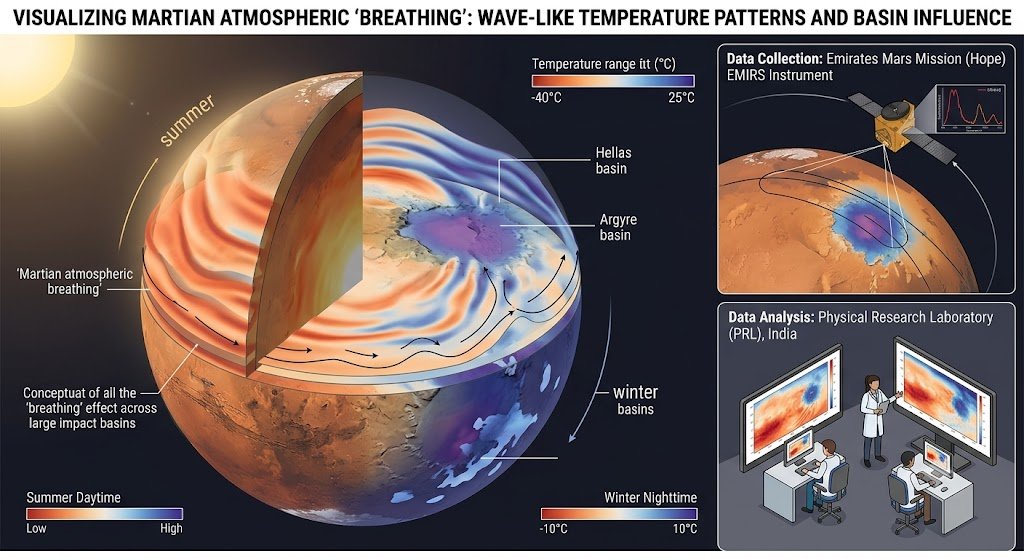
AHMEDABAD: Mars may appear cold, dry and lifeless from Earth, but new observations have revealed a dynamic world where temperatures undergo dramatic shifts and move in wave-like patterns across the planet’s surface.
Scientists from the Physical Research Laboratory (PRL), Ahmedabad, have mapped temperature variations across two of Mars’ largest impact basins — Hellas and Argyre — using data collected by the United Arab Emirates’ Emirates Mars Mission Hope spacecraft.
The study, published in Current Science, provides new insights into how heat moves across the Martian surface and how massive geological formations can influence atmospheric circulation on the Red Planet.
The researchers analysed infrared observations obtained by the Emirates Mars Infrared Spectrometer (EMIRS), an instrument aboard the Hope spacecraft designed to measure infrared radiation from the Martian surface.
The observations revealed striking temperature variations across the regions studied. Surface temperatures were found to range from approximately 150 Kelvin (-123°C) to nearly 295 Kelvin (22°C).
Extreme temperature swings across Mars
According to the study, Mars experiences significant heating and cooling as its seasons change. The planet’s thin atmosphere plays an important role in these extreme variations, while its rugged terrain and enormous impact basins further influence how heat is distributed.
During the Martian summer, temperatures in some regions can approach 300 Kelvin, equivalent to around 27°C. With the arrival of winter, however, surface temperatures can plunge to approximately 160 Kelvin, or -113°C.
These dramatic seasonal changes provide scientists with an opportunity to study the interaction between Mars’ surface and its atmosphere.
The temperature maps generated from Hope spacecraft observations also revealed wave-like patterns spreading across the Martian surface. Researchers found that these patterns are connected to the planet’s thin atmosphere and the influence of major geological features.
The Hellas and Argyre basins are particularly significant because of their enormous size and distinctive topography. Such large-scale terrain features can affect atmospheric circulation and the way heat is transported across the planet.
The findings therefore offer scientists a closer look at what could be described as Mars’ atmospheric “breathing” — the recurring movement and redistribution of heat as the planet moves through its seasons.
The study demonstrates how observations from the Hope mission can help scientists understand the complex relationship between Mars’ surface, atmosphere and geological landscape.
For Indian researchers, the work also highlights the scientific value of analysing data from international planetary missions. The EMIRS observations are allowing scientists to study Mars’ thermal environment in greater detail and build a clearer picture of the physical processes shaping the Red Planet.