
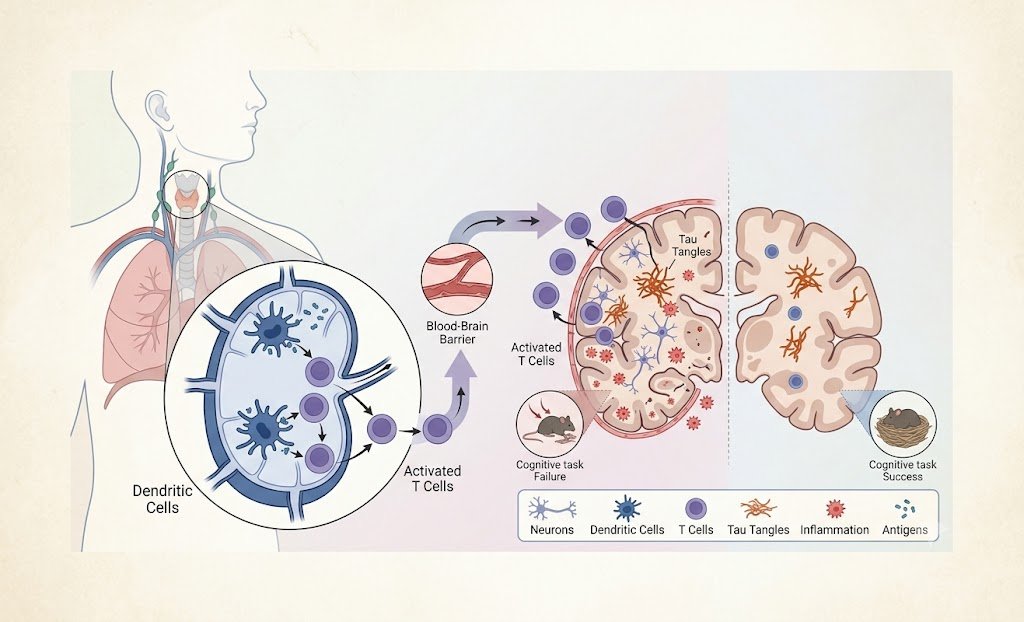
WASHINGTON: The process that drives Alzheimer’s-related brain damage may begin outside the brain, with immune cells in the lymph nodes potentially helping to activate the inflammatory response that contributes to neurodegeneration.
A new study in mice suggests that a small population of immune cells called dendritic cells, located in lymph nodes, may play a key role in preparing T cells to attack the brain. The findings, published September 3 in Nature Neuroscience, raise the possibility of developing treatments that target the immune response outside the brain rather than attempting to deliver therapies through the brain’s protective blood-brain barrier.
For years, much of Alzheimer’s research has focused on removing toxic proteins such as amyloid and tau from the brain. While these approaches have produced limited success, researchers have increasingly recognised that the immune system also plays an important role in neurodegeneration.
In 2023, neurologist David Holtzman and colleagues reported that T cells accumulate around tau tangles in the brain, suggesting that these immune cells could contribute to neurological damage. Preventing T cells from entering the brain reduced inflammation as well as neuronal damage, according to that earlier research.
The latest study examined a key question: Where are these T cells being activated before they reach the brain?
T cells are activated, or “primed”, when they encounter signals indicating a potential threat. Dendritic cells play a crucial role in this process. They capture molecular signatures known as antigens and present them to T cells, effectively initiating an immune response.
Holtzman and his colleagues investigated the role of these cells in mice genetically engineered to develop tau-associated neurodegeneration.
The researchers compared mice with the disease model with animals in which dendritic cells had been eliminated or their ability to activate T cells had been disrupted.
Older mice lacking dendritic cells still had substantial amounts of tau in their brains. However, they showed significantly less neurodegeneration and performed better on cognitive tasks, including nest-building activities.
According to the researchers, the findings suggest that tau accumulation alone may not fully explain the extent of neuronal damage. Instead, the inflammatory response triggered by the immune system could be responsible for a significant part of the damage associated with tau.
The researchers found relatively few dendritic cells inside the brains of the mice. Instead, they detected brain-derived proteins resembling potential danger signals travelling to lymph nodes.
There, dendritic cells appeared to use these signals to activate T cells. The activated immune cells could then enter the brain and contribute to inflammation and neurodegeneration.
In another experiment, the researchers bred mutant mice with dendritic cells that could no longer effectively activate T cells. These animals also showed fewer T cells in the brain and better-preserved brain structures.
The findings remain preliminary because the experiments were conducted in mice, and the mechanism needs to be established in humans before it can be considered a potential treatment strategy.
Researchers also caution that dendritic cells are essential components of the immune system, making it impractical to simply eliminate them in people from birth.
The potential therapeutic approach could instead involve identifying ways to selectively suppress or modify the relevant dendritic-cell activity in adulthood.
If the mechanism is confirmed in humans, it could open a different route for Alzheimer’s treatment — one that targets immune activity outside the brain and potentially avoids the challenge of delivering drugs across the blood-brain barrier.