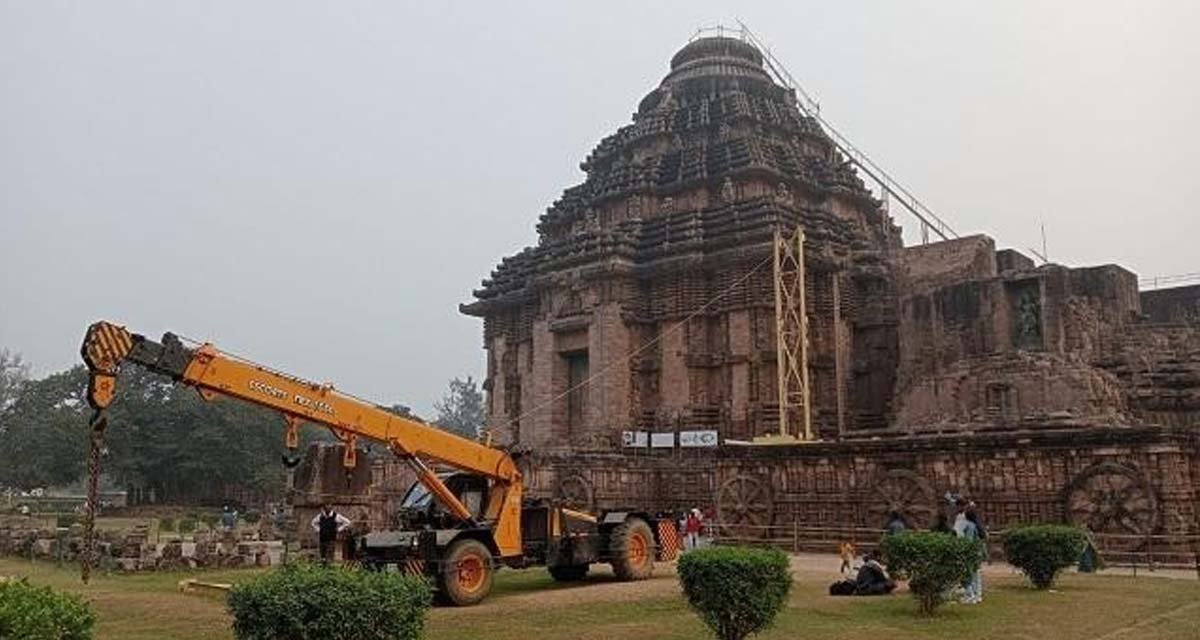
Bhubaneswar: The Archaeological Survey of India (ASI) has begun a major conservation exercise at Odisha’s iconic Konark Sun Temple to remove sand that has remained inside the Jagamohan, or assembly hall, for more than a century.
The historic structure was filled with sand and sealed in 1903 during the British era as a measure to prevent the Jagamohan from collapsing. More than 120 years later, the sand is now being carefully removed as part of a scientific conservation programme.
Located on Odisha’s coast, the 13th-century Konark Sun Temple was built by King Narasimhadeva I of the Eastern Ganga dynasty. Designed as a colossal chariot of the Sun God, the temple is renowned for its 24 intricately carved stone wheels and seven horses.
The temple’s wheels are among its most remarkable features. Their design is associated with the measurement of time through the movement of shadows, reflecting the advanced astronomical knowledge incorporated into the temple’s architecture.
The Jagamohan stands in front of the sanctum and is one of the best-preserved major structures of the temple complex. While several parts of the original temple have been damaged or lost over the centuries, the Jagamohan has survived.
The decision to fill the structure with sand was taken when concerns grew over its structural stability. The sand provided internal support and helped prevent further collapse. However, over the years, changes in the sand and the formation of voids inside the structure raised fresh concerns about the long-term stability of the monument.
ASI, along with technical experts and institutions involved in the structural assessment, has been studying the condition of the monument before undertaking the removal work.
The current operation involves creating a controlled access passage and removing the sand in a carefully monitored manner. The work is being carried out with special attention to the stability of the historic stone structure. Technical methods, including drilling and controlled extraction, are being used to minimise any impact on the monument.
The removal of the sand is not simply aimed at opening a sealed chamber. It will allow conservation experts to examine the internal structure of the Jagamohan more closely and assess its condition after decades of being buried.
Once the operation is completed, experts will have an opportunity to study parts of the structure that have remained inaccessible for around 123 years.
The Konark Sun Temple was declared a UNESCO World Heritage Site in 1984 and remains one of India’s most important monuments of architecture, sculpture and astronomical knowledge.
The ongoing conservation work is therefore being closely watched, as it could provide valuable information about the condition of the centuries-old monument while helping authorities plan its long-term preservation.