
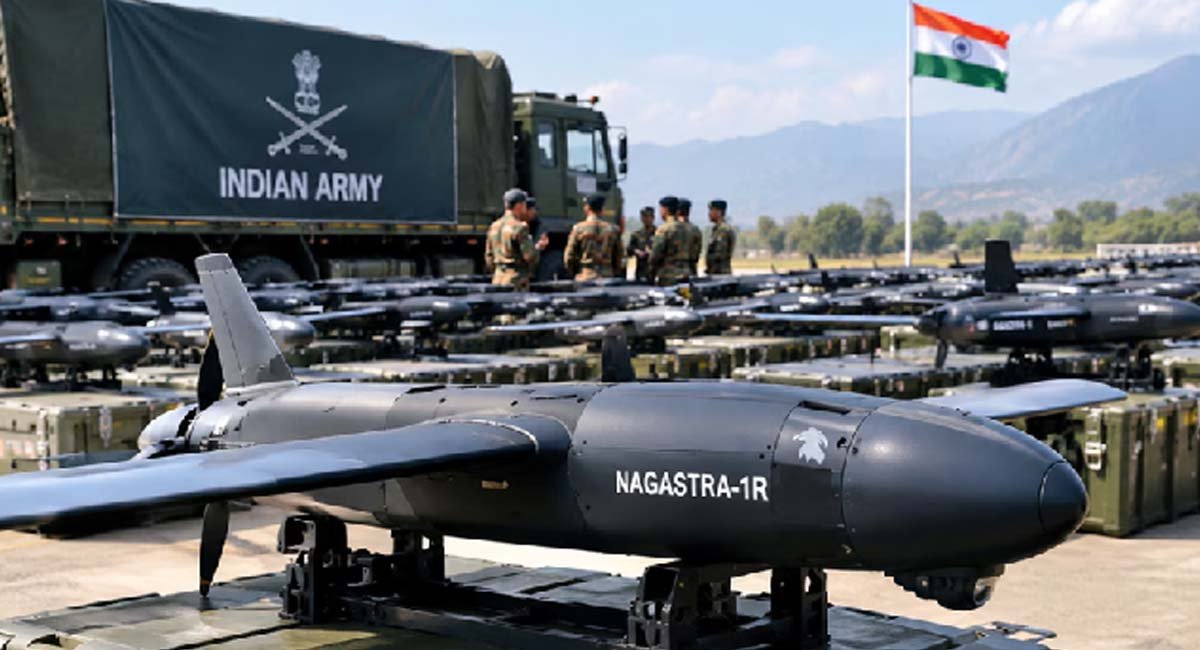
Indigenous loitering munitions to boost precision strike capabilities; drone offers a reported range of up to 30 km
New Delhi: The Indian Army has received 450 Nagastra-1R loitering munitions in a single consignment, marking the largest reported one-time supply of such weapons from a single manufacturer. The initial batch was delivered to the Pulgaon Ammunition Depot in Maharashtra under an emergency procurement agreement after successfully completing Pre-Delivery Inspections (PDI).
The Nagastra-1R is an indigenous loitering munition designed to carry out precision strikes against designated targets. According to reports, the fixed-wing electric drone can achieve an accuracy of around two metres using GPS guidance. It has an operational range of 15 km in man-in-the-loop mode and up to 30 km in autonomous mode, with an endurance of approximately 30 minutes.
One of the system’s key features is its electric propulsion, which produces a low acoustic signature and reduces the chances of detection. The drone is equipped with day-and-night surveillance cameras and a one-kilogram high-explosive fragmentation warhead designed for use against soft-skinned targets.
The system also features a parachute-based recovery mechanism, allowing the drone to be recovered and reused in suitable circumstances. Its portability is another advantage, with the complete system weighing around 30 kg and packed into two rucksacks. The equipment includes a Ground Control Station, communication systems, payload and pneumatic launcher.
The Nagastra-1R has been developed by Economic Explosives Limited (EEL) in collaboration with Bengaluru-based Z-Motion Autonomous Systems. More than 75 per cent of the system is reportedly indigenous, highlighting India’s push towards self-reliance in defence manufacturing.
The induction of the drones is expected to strengthen the Army’s precision-strike capabilities and provide additional operational options along strategic border sectors. Their range, portability and precision-guidance features could support missions against hostile positions and other designated targets while reducing the exposure of personnel to direct enemy fire.