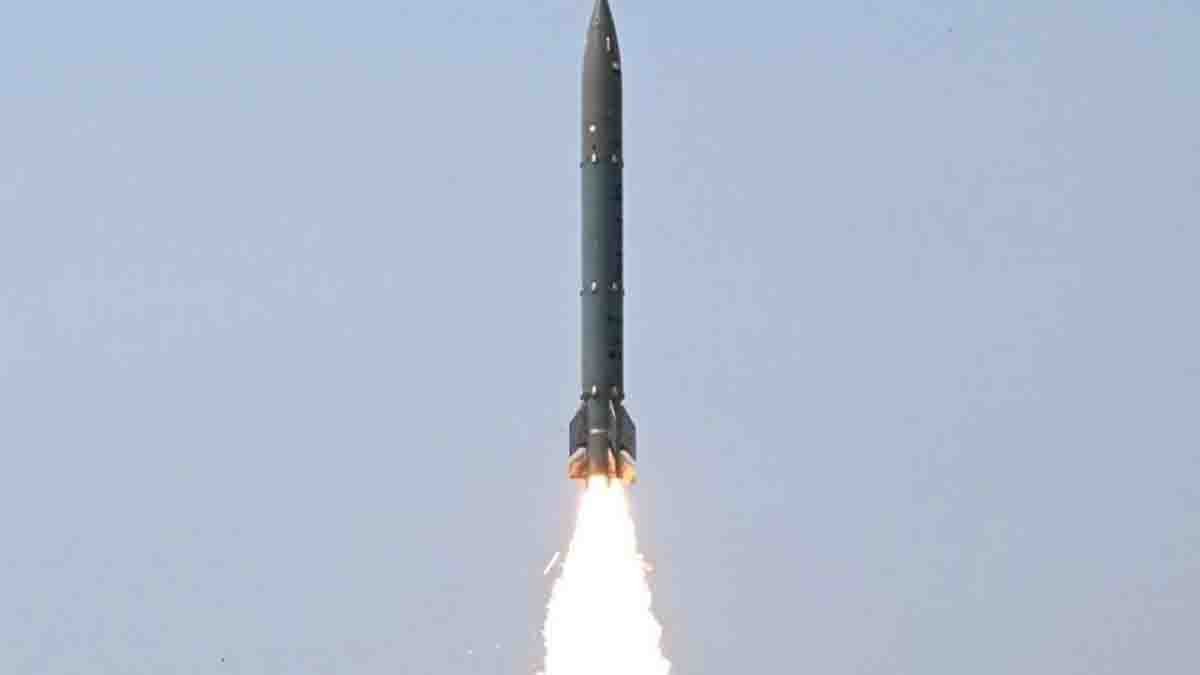
New Delhi: India has achieved another milestone in indigenous defence technology, with the Defence Research and Development Organisation (DRDO) successfully conducting a flight test of its Pralay surface-to-surface missile off the Odisha coast on Thursday.
The test was conducted at 11:10 am as part of the missile’s User Evaluation Trials. Defence Minister Rajnath Singh announced the successful trial and congratulated the DRDO team for the achievement.
According to reports, all the objectives set for the test were successfully met. Data collected through various tracking and monitoring systems confirmed the missile’s performance during the trial. Singh described the achievement as another important step towards strengthening India’s indigenous defence capabilities.
Pralay is an indigenously developed solid-propellant, quasi-ballistic missile designed for surface-to-surface strikes. It uses advanced guidance and navigation systems to achieve high accuracy and can carry different types of warheads. The missile has a reported strike range of approximately 150 to 500 kilometres.
The latest test comes amid a series of developments in India’s indigenous defence technology programme.
DRDO’s high-altitude platform test
Earlier, on October 6, DRDO successfully conducted a flight trial of its indigenously developed High-Altitude Platform (HAPS).
During the experimental flight, the platform reached an altitude of 21 kilometres above mean sea level and remained at 20 kilometres for more than 30 minutes. It was subsequently commanded to descend and was successfully recovered, according to the Defence Ministry.
The HAPS system is being developed as a long-endurance aerial platform capable of operating in the stratosphere. Such platforms can support surveillance, communication and other monitoring missions over extended periods.
Throughout the trial, the platform transmitted real-time video and flight-performance data to a Ground Control Station. The system was equipped with an inertial measurement unit, GPS receiver, onboard cameras, an altitude-control mechanism and other electronic subsystems. The data collected during the flight indicated that the platform performed as intended.
The HAPS trial was conducted in coordination with the Indian Air Force, the Centre for Military Airworthiness and Certification (CEMILAC), the Directorate General of Civil Aviation (DGCA), the Airports Authority of India (AAI) and other civil authorities.
The successful Pralay missile test and the earlier HAPS trial underline DRDO’s ongoing efforts to develop indigenous systems for India’s defence and surveillance requirements.