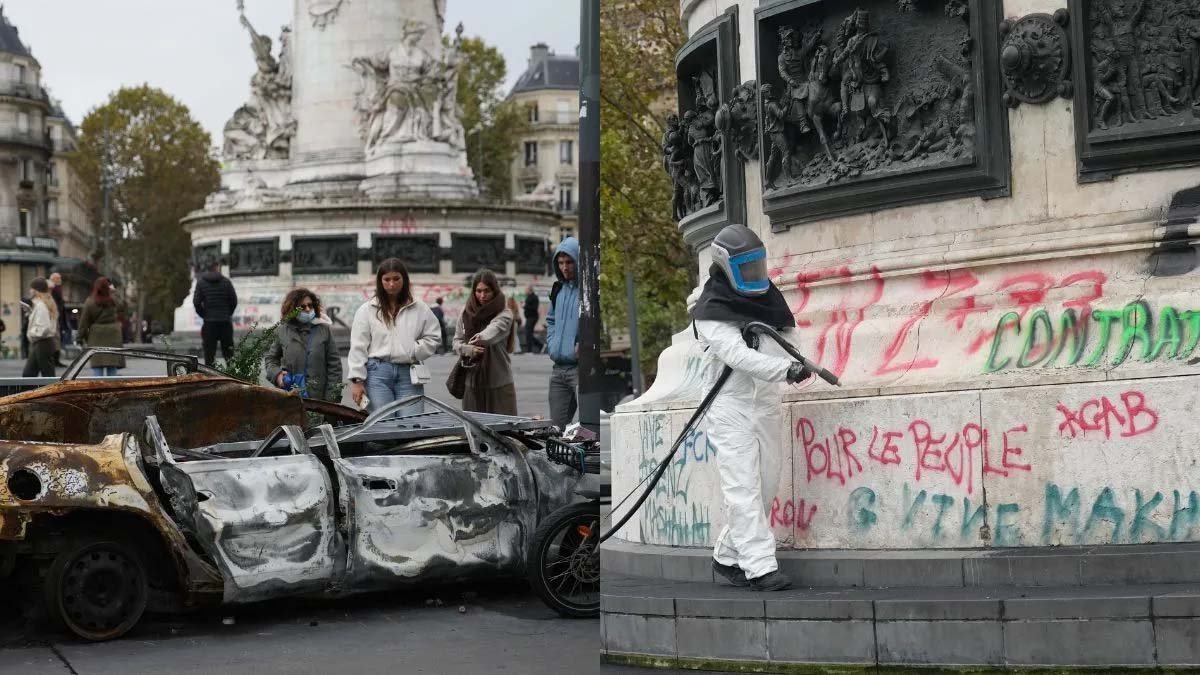
Paris: France witnessed a fresh wave of protests on Saturday, October 24, as demonstrators took to the streets over rising living costs, education funding and economic inequality. Clashes broke out in Paris and several other cities, prompting police to use tear gas, batons and water cannons to disperse crowds.
French Interior Minister Laurent Nunez said nearly 1,000 people were arrested during the demonstrations. Authorities deployed approximately 70,000 police officers and other security personnel nationwide amid concerns that the unrest could escalate ahead of the presidential election scheduled in six months.
Here are 10 key developments from the latest protests across France.
1. Protests spread across the country
Hundreds of demonstrations took place nationwide on Saturday, reflecting growing public anger over household expenses, education funding and economic inequality. What began as student protests over school conditions has expanded into a broader movement challenging government policies.
2. Nearly 1,000 people arrested
Interior Minister Laurent Nunez confirmed that police arrested nearly 1,000 people during the demonstrations. He described the violence involving groups dressed in black as exceptionally severe and blamed what he identified as ultra-left extremists for some of the confrontations.
3. 70,000 security personnel deployed
The government mobilised around 70,000 security personnel to prevent a repeat of the previous weekend’s unrest. Reinforced police units, helicopters, armoured vehicles and water cannons were deployed in several locations. The heightened security presence followed criticism of the authorities’ response to earlier incidents of vandalism, looting and street violence.
4. Dispute over protest turnout
Official and union estimates differed significantly over the number of demonstrators. France’s Interior Ministry estimated nationwide participation at approximately 410,000, while the CGT trade union put the figure at around 800,000. Estimates for the main Paris march ranged from 110,000 to 250,000.
5. Tear gas used in major cities
Police used tear gas to disperse demonstrators in Paris, Marseille, Lyon, Bordeaux, Lille, Toulouse, Montpellier and Nantes. Although the main Paris march remained largely peaceful, confrontations erupted as crowds dispersed. Officers charged protesters and used batons during some clashes.
6. Two people seriously injured
Nunez reported that two people sustained serious injuries during the demonstrations. One was a man in Toulouse who reportedly lost several fingers in an explosion. The second person was injured in Clermont-Ferrand. Authorities have not released further details about the latter incident.
7. Clashes and looting reported
In Lyon, police deployed tear gas against demonstrators who attempted to block a road in an area where protests had been prohibited. In Nantes, thousands of protesters reportedly broke through police lines amid the use of tear gas and water cannons. Clashes also occurred in Lille, Marseille, Montpellier and Toulouse, while police reported looting on the sidelines of demonstrations in Marseille and Grenoble.
8. Restrictions on demonstrations draw criticism
Authorities imposed restrictions on protest routes and prohibited gatherings in certain areas. In Paris, organisers and demonstrators were directed away from central shopping districts towards the southeastern outskirts of the capital. Civil society groups and protesters criticised the restrictions, arguing that they could undermine the right to peaceful assembly. Several shops boarded up their windows, while the Louvre and Musée d’Orsay remained closed amid security concerns.
9. Counter-protests target Marine Le Pen’s National Rally
Political tensions also intensified in Orléans, where Marine Le Pen’s far-right National Rally party held a two-day congress as it prepared for the presidential election campaign. Thousands of counter-protesters, including left-wing groups, trade unions, student organisations and activists, rallied against the party.
Jordan Bardella was re-elected president of the National Rally during the congress.
10. Rising costs and education concerns fuel unrest
The protests initially emerged from students’ concerns about staff shortages and school conditions but have since broadened to include demands for better education funding and relief from rising household expenses. Increasing fuel and energy costs have added to public frustration.
The unrest has heightened political pressure on President Emmanuel Macron’s government as it seeks to maintain public order ahead of the presidential election. The Yellow Vests movement, which staged major protests against Macron in 2018, has also called for further demonstrations on October 31.
Nunez said the security operation had produced a more positive outcome than the previous weekend, crediting the increased police presence and preventive checks. However, the latest clashes highlight the government’s continuing challenge of containing violence while addressing public concerns over living costs and restrictions on demonstrations.