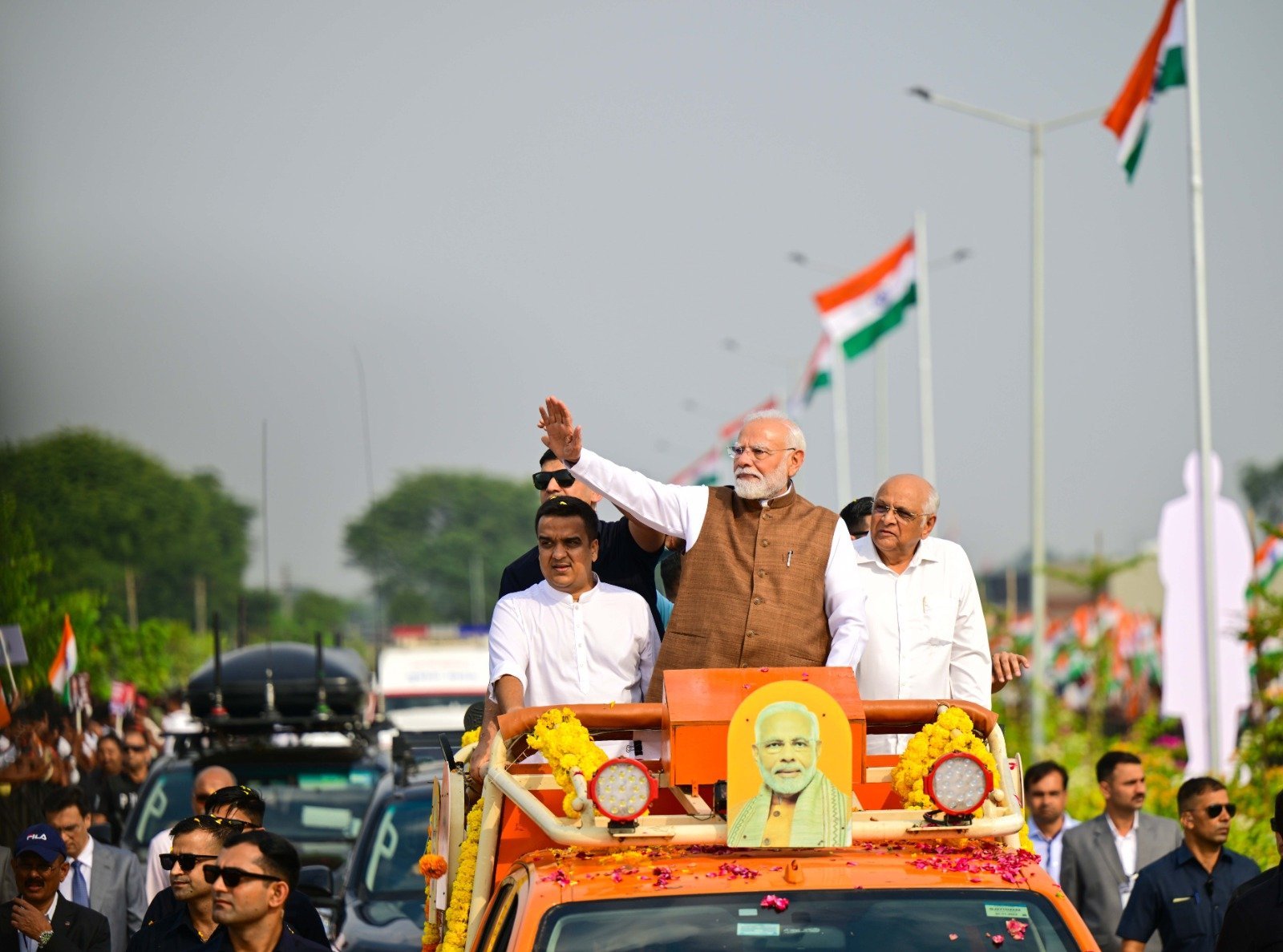
Banaskantha: Prime Minister Narendra Modi on Friday accused opposition parties of exploiting the ongoing conflict involving Iran and tensions in the Gulf region to spread rumours and create panic in India. He alleged that instead of standing with the government during a period of international uncertainty, some political groups were attempting to use the situation for political gains.
Addressing a public gathering in Gujarat’s Banaskantha district, Modi said misleading claims were being circulated about possible shortages of fertilisers and cooking gas amid the West Asian conflict. He alleged that such campaigns were intended to create confusion among the public and discredit the government.
“When the country faces a crisis, some people feel happy,” Modi said, criticising those whom he accused of spreading rumours while the nation was collectively dealing with the situation. His remarks were reported by the Prime Minister’s Office and the Press Information Bureau.
Government Absorbing Fertiliser Price Burden, Says Modi
The Prime Minister said the government had taken steps to prevent the sharp rise in international fertiliser prices from placing an additional burden on Indian farmers. He said subsidies and other support mechanisms were being used to protect cultivators from fluctuations in the global market.
Citing the difference between international and domestic prices, Modi said a bag of urea costing around ₹3,000 in the international market was being made available to Indian farmers for less than ₹300. Similarly, a bag of di-ammonium phosphate (DAP), priced at more than ₹5,000 internationally, was being supplied to farmers for ₹1,350.
The government was bearing the additional cost through subsidies to ensure that farmers were not exposed to the full impact of global price increases, he said.
Modi also claimed that various government policies and schemes had delivered financial benefits and savings worth more than ₹50 lakh crore to farmers.
Soil Health Cards and Climate-Resilient Seeds
Highlighting the role of science and technology in agriculture, Modi said the government had taken several initiatives over the past 12 years to modernise farming, animal husbandry and the dairy sector.
He cited the Soil Health Card scheme as an important initiative that helps farmers understand the quality and nutrient composition of their soil and determine the appropriate quantity of fertilisers required for cultivation.
More than 26 crore Soil Health Cards have been distributed across the country, he said. The scheme enables farmers to make informed decisions about fertiliser application based on the characteristics of their soil and agricultural land.
The Prime Minister also highlighted efforts to make agriculture more resilient to changing weather conditions. He said around 3,000 new varieties of seeds had been made available to farmers in recent years, including varieties intended to withstand climate-related challenges.
Women’s Role in Dairy and Animal Husbandry
Modi also underlined the contribution of women to dairy development and animal husbandry, describing these sectors as important pillars of the rural economy.
He said improved livestock breeds could help increase milk production and that the government had focused on expanding the use of science and technology in these sectors over the past decade.
The Prime Minister reiterated that farmers would remain central to India’s ambition of becoming a developed nation.
Modi Recalls 25 Years in Public Life
During the address, Modi recalled taking charge as Gujarat Chief Minister in October 2001, marking 25 years in public life in a leadership role.
He said he would continue serving the people until his last breath.
The speech combined criticism of the Opposition over its response to the international conflict with the Prime Minister’s defence of the government’s agricultural policies and support measures for farmers.